

Welcome. My name is Daz Smith, a long-time remote viewer, researcher, and instructor based in the United Kingdom. I have spent more than two decades studying, practicing, and researching remote viewing and its applications.
The goal of this website is simple: to make the most comprehensive collection of remote viewing information, documents, and resources available online.
If you are looking for reliable information about remote viewing, its history, methods, and real-world applications, you are in the right place.
This site contains one of the largest online archives of remote viewing material, including:
- Free remote viewing manuals and training guides
- Historical research on the Star Gate remote viewing program
- CIA and DIA FOIA documents
- Remote viewing targets and practice material
- Real remote viewing session examples
- Profiles of the major military and civilian remote viewers
- Links, resources, and research articles
You will also find original session data and projects from both civilian practitioners and former U.S. military remote viewers involved in the government’s remote viewing research programs.

What is Remote Viewing?
A 1979 SECRET progress report from the Stanford Research Institute (SRI) to the Defense Intelligence Agency defined remote viewing as:
“The acquisition and description, by mental means, of information blocked from ordinary perception by distance or shielding, and generally believed to be secure against such access.”
— SRI Quarterly Progress Report to the DIA, January 10, 1979
A modern definition might describe remote viewing as:
Remote viewing is the intuitive ability—enhanced through training—to perceive and describe mulit-form information about distant or hidden targets independent of time, space, or physical location.
Remote viewing is conducted using strict scientific protocols, including blind targeting, documentation, recording, and feedback.
The History of Remote Viewing
Remote viewing was originally researched as part of a U.S. military and intelligence program designed to explore whether human consciousness could access information beyond normal sensory perception.
From 1972 to 1995, scientists at Stanford Research Institute (SRI) conducted experiments into psychic perception under controlled scientific conditions. This work eventually evolved into operational programs within the U.S. Army, DIA, and CIA, commonly known as The Star Gate Program.
Over more than two decades, the U.S. government invested approximately $20 million researching and developing remote viewing as an intelligence-gathering tool.
The result was the development of structured remote viewing methodologies, including the system created by Ingo Swann, known as Controlled Remote Viewing (CRV).
How Remote Viewing Works
Remote viewing is a structured method for accessing subtle intuitive impressions about a target. A trained practitioner—known as a remote viewer —records perceptions about a location, object, event, structure, or lifeform without any prior knowledge of the target.
Unlike traditional psychic practices, remote viewing follows strict protocols designed to reduce imagination and analytical guessing.
These protocols typically include:
- Blind targeting (the viewer does not know the target)
- Structured stages of perception
- Full session recording
- Independent feedback
Most modern methods of remote viewing are derived from Controlled Remote Viewing (CRV), the structured system developed during the early SRI research.
Today there are several variations and offshoots of these original methodologies, but they all maintain the same core principles of structure, protocol, and repeatable results.
What Remote Viewing Is Not
Remote viewing is not the same as traditional psychic readings.
It is not used for:
- Fortune telling
- Personal psychic readings
- Face-to-face intuitive sessions
Instead, remote viewing is practiced as a disciplined research and intelligence-gathering methodology.
Projects are always conducted blind, fully documented, and designed so that the recorded data could only have been obtained through intuitive perception rather than normal communication.
Remote viewing has been applied in areas such as:
- Scientific research
- Intelligence analysis
- Criminal investigations
- Business and commercial research
- Historical and archaeological exploration
The Remote Viewing Community Today
Since the declassification of the Star Gate Program, remote viewing has grown into a global civilian research community.
Many of the original military remote viewers now teach the methodology publicly, and their students have gone on to create training programs, research projects, and professional applications of remote viewing around the world.
Today remote viewing is practiced by researchers, scientists, analysts, and intuitive practitioners exploring the nature of consciousness and perception.
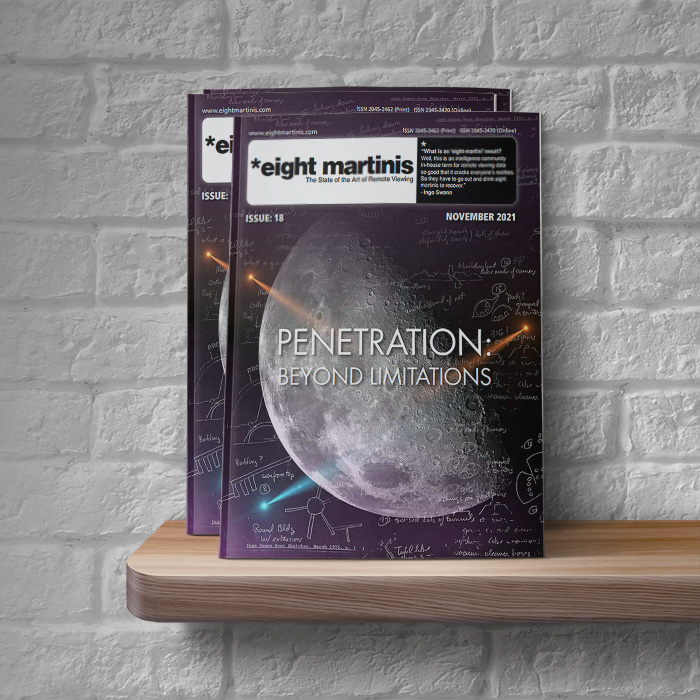
Eight Martinis – The Remote Viewing Magazine
For deeper insights into the world of remote viewing, download the **free magazine** *Eight Martinis*.
*Eight Martinis* is a publication dedicated to the **practice, research, and development of remote viewing**. Each issue features:
- Remote viewing sessions and projects
- Research articles
- Interviews with leading practitioners
- News and developments in the field
The magazine is available as a free downloadable PDF or as a full-color printed edition delivered to your door.
New to Remote Viewing?
If you are new to the subject, the best place to start is our:
Beginner’s Guide to Remote Viewing
This guide explains the basics of remote viewing, the history of the practice, and how you can begin learning the methodology yourself.